
Guide7 min read
Trail Camera Flash Types: No-Glow, Low-Glow, and White Flash
No-glow vs low-glow vs white flash, explained in plain terms. How 850nm and 940nm infrared differ on night range, stealth, and image quality, and which fits your setup.

Low-Glow, No-Glow, and White Flash in Plain Terms
Every trail camera lights its night shots one of three ways, and the choice shapes both your photos and how much attention the camera draws. Get it right up front and you avoid the most common regret buyers post on Rokslide and Bowsite: a camera that either spooks deer or takes muddy night images.
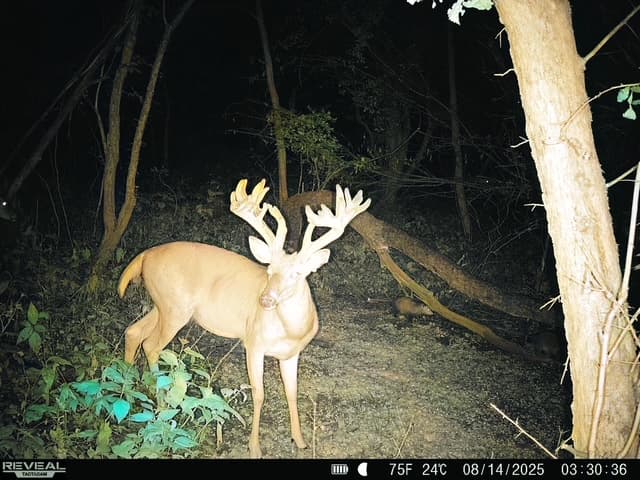
Low-glow cameras use infrared LEDs that emit a faint red dot when they fire. Stand behind one in full dark and you might catch it. A deer at 30 feet almost never reacts. No-glow cameras use a different infrared wavelength that produces no visible light at all, so the camera stays invisible to animals and to the person walking the property line. White-flash cameras fire a true visible flash, like a point-and-shoot, and return full-color night photos at the cost of a bright burst every time they trigger.
Most hunters live in the low-glow and no-glow world. White flash is a specialty tool for color inventory at feeders and food plots where you are not worried about tipping off game or a passing stranger.
The Wavelength Behind the Glow
The whole difference comes down to one number on the spec sheet: the infrared wavelength, listed in nanometers.
Low-glow arrays run at 850nm. At that wavelength the LEDs throw more light and reach farther, but the emitter glows a dim red while it works. No-glow arrays run at 940nm. Human and animal eyes cannot register 940nm, so nothing shows in the dark, and the tradeoff is that 940nm light carries less energy and covers less ground for the same LED count.
That is the entire mechanism. When a listing says "invisible flash" or "black IR," it is describing a 940nm no-glow array. When it advertises long night range and a "low-glow" or "red glow" flash, it is running 850nm. A camera cannot do both from one array, so manufacturers pick a lane per model.
Range and Image Quality: The Real Tradeoff
This is where the decision shows up in your photos. An 850nm low-glow camera typically lights a subject cleanly out to 70 or 80 feet, and premium models push past 100 feet. A 940nm no-glow camera on the same body usually tops out around 40 to 60 feet before the image goes soft and grainy in the far corners.
Daytime color is identical between the two, since both shoot through the same sensor in daylight and only the night array differs. The gap opens after dark. Low-glow night photos hold more detail at distance, which is why open-country hunters watching a field edge lean that way. No-glow shines in tight quarters, a pinch point, a narrow trail, a mock scrape 25 feet off, where range is short and stealth is the point.
It helps to see why the physics works this way. Both arrays measure their wavelength in nanometers, and the human eye stops registering red light somewhere around 900nm. An 850nm emitter still falls inside that visible band by a hair, which is the faint red wink you catch behind a low-glow camera in full dark. Push the wavelength to 940nm and you clear the edge of human and animal vision entirely, so nothing shows. The same jump that buys you invisibility also costs you photons, because longer-wavelength light delivers less energy to the scene. That is the physical reason a no-glow camera cannot match a low-glow one on raw night reach from the same number of LEDs. No firmware setting closes that gap. It is baked into the wavelength the manufacturer chose.
Two practical notes buyers miss:
- No-glow arrays draw more power to hit the same brightness, so battery life often runs shorter on a 940nm model than an 850nm one with a comparable rating.
- A low-glow red flash sits below the color range deer see well, which is why field reports of spooked deer are rare even with 850nm. Pressured public-land bucks and coyotes are the exception worth planning around.
Which Flash Fits Your Setup
Match the flash to the location, not to a blanket rule.
Choose no-glow (940nm) when the camera sits on a property boundary, a shared access trail, or public ground where theft is a concern, or over a close-range scrape where a buck's nose is 20 feet from the lens. Invisibility is the whole job there.
Choose low-glow (850nm) when you need night reach across a field, a power-line cut, or a bait site at 60-plus feet, and the camera is deep enough on private ground that a faint red wink at 2 a.m. changes nothing. You get brighter, sharper night images for the same money.
Reach for white flash only when color identification at night outweighs everything else, such as cataloging individual bucks by coat and rack detail at a managed feeder. Be honest about the tradeoff before you hang one. A visible burst every few minutes announces the camera to anything with eyes, deer and people alike, so a white-flash body belongs deep on ground you control, never on a boundary or a public trail.
A Quick Reference Table
| Flash type | Wavelength | Visible? | Night range | Best for | | --- | --- | --- | --- | --- | | Low-glow | 850nm | Faint red dot | 70 to 100+ ft | Field edges, open country, long shots | | No-glow | 940nm | Nothing | 40 to 60 ft | Boundaries, close scrapes, high-pressure ground | | White flash | Visible | Bright burst | Varies | Color night ID at feeders and plots |
Print this, tape it inside your gear tote, and buy to the location you are actually hanging the camera on.
Our No-Glow Pick
If your setups favor stealth, a purpose-built 940nm camera beats a low-glow model you have to hope deer ignore.
Based on aggregated research across manufacturer specifications and more than 1,800 verified Amazon buyer ratings, we recommend the Browning Dark Ops HD Pro X for hunters who want a true no-glow flash without giving up image quality. It publishes a 24-megapixel sensor, an 0.22-second trigger speed, and an 80-foot no-glow detection range, which sits at the long end of what 940nm arrays reach. That range buys back much of the reach you normally trade away for invisibility. For the rest of the field, see our best no-glow trail cameras and the placement tips that get the most out of a short-range flash.
Sources
This guide draws on the following sources:
Recommended for this guide
If you need one, start here.

24MP no-glow flash with a 0.2-second trigger, the best invisible-flash camera for serious deer hunters under $150.
Common questions
Frequently asked.
Jake
. Research Editor, BestTrailCamera.com