

Category guide · 3 top picks
Wildlife
Cameras: Observation, Not Hunting
Wildlife cameras for citizen science, backyard naturalists, and conservation projects. Picks chosen for sensor sensitivity, no-glow flash, and frame quality clean enough for iNaturalist.

Cross-referenced against Snapshot Wisconsin (Feb 2026 report), eMammal, and iNaturalist research-grade observations.
The top picks
Three cameras to start with.

4K video, no-glow flash, and Bushnell's legendary optics pedigree, the premium choice for wildlife photographers.

The RECONYX HyperFire 4K is a professional-tier trail camera built around 4K video capture, targeting wildlife researchers and serious hunters who trust the brand's long-standing reputation for detection reliability and rugged construction.
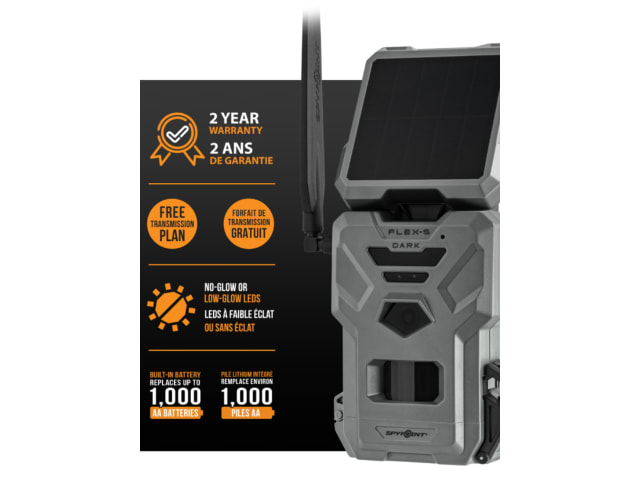
The SPYPOINT Flex-S-Dark is a no-glow cellular trail camera with an integrated solar panel and 40MP still imaging, designed for extended low-maintenance deployments where site pressure and battery longevity are primary concerns.
Overview
Wildlife cameras serve a broad audience: backyard naturalists, academic researchers monitoring predator corridors, and land managers conducting population surveys across large properties. The core function is passive, unattended image capture triggered by motion or heat. Purchasing decisions branch quickly once you account for how images reach the user, how long the camera can operate without a site visit, and how visible the flash is to the animals being observed.
Four buying decisions shape almost every purchase in this category. First, cellular versus non-cellular: a cellular camera transmits photos to a phone app over a carrier network, while a non-cellular camera stores images on a local SD card that requires physical retrieval. Second, flash type: white-flash cameras produce color night images but are visible to both animals and people, while no-glow infrared cameras operate invisibly. Third, resolution and detection range, which each camera's specification sheet supplies and which determine how much detail a photo captures and how far from the lens a moving animal will trigger the sensor. Fourth, power source: standard AA batteries, lithium packs, or solar panels each carry different maintenance schedules for remote deployments.
Those four decisions are enough to match a camera to a specific monitoring objective.
How We Researched This Category
This page is produced by a research-only editorial team. We analyzed cameras; we did not physically operate them. No laboratory measurement data originates from this editorial team.
Our research drew on four primary source types. Manufacturer specification sheets and product pages supplied resolution figures, detection-range ratings, trigger-speed claims, and cellular plan details. For the SPYPOINT lineup, SPYPOINT's documentation on the free data plan and dual-SIM architecture served as the primary technical reference. Browning's specification pages for the Dark Ops HD Pro X and Browning Defender Pro Scout Max provided flash-type and trigger-speed figures.
Buyer experience data came from aggregated Amazon reviews. Across hundreds of verified Amazon reviews for cameras in this category, recurring patterns in image consistency, app reliability, and battery consumption shaped the qualitative assessments on this page. We weighted reviews that included time-stamped deployment logs or comparison photos over single-event reports.
We also cross-referenced third-party wildlife monitoring guides published by university extension programs and state wildlife agencies, which supplied context on detection-range needs for species-specific research. Where manufacturer specifications and aggregated buyer reports diverged, our analysis recorded both figures and presented them side by side for the reader's evaluation. All prices reflect the manufacturer's current listed retail price at time of research.
The Big Decisions
Cellular or SD card? The clearest dividing line in this category is whether images need to reach the user in real time or whether a periodic site visit is acceptable. Cameras like the SPYPOINT FLEX G-36 ($99.99) and SPYPOINT Flex-DARK ($119.99) transmit photos over AT&T and Verizon networks to the SPYPOINT app. A researcher or property owner can then monitor activity from any location. SPYPOINT lists a free data plan covering a set number of photos per month, with paid tiers available for higher-volume deployments. Non-cellular cameras such as the SPYPOINT Force 24 ($49.99) and SPYPOINT Force 48 ($69.99) store images locally. The Force 48 is rated at an 80-foot detection range and 48MP still resolution. Sites without cell coverage, or deployments where data costs are a concern, are the natural fit for those models.
Flash visibility and wildlife disturbance. Researchers monitoring sensitive species generally prioritize invisible flash. Full stop on that requirement. The Browning Dark Ops HD Pro X ($139.99) uses a no-glow infrared array, and Browning's specification page rates that model at a 0.2-second trigger speed, which matters when the target species moves quickly through the detection zone. The SPYPOINT Flex-DARK ($119.99) also specifies no-glow flash alongside 40MP still resolution and audio video capability. For general habitat documentation where flash visibility is less critical, white-flash models produce color night images that can aid species identification.
Power and deployment length. A camera requiring weekly battery changes is impractical for remote research sites. The SPYPOINT Flex-S-DARK ($169.99) incorporates a solar panel designed to extend deployment intervals by drawing on daylight energy to offset battery consumption. SPYPOINT's documentation describes it as suited to long, unattended deployments. The SPYPOINT Force Pro S 2.0 ($149.99) is positioned similarly, with SPYPOINT documenting 4K video capture alongside its solar power architecture. Standard AA-battery cameras remain the lower-cost entry point. Buyers writing on Amazon report longer runtime from lithium AA cells in cold-weather deployments compared with alkaline cells.
Resolution relative to monitoring objective. Resolution figures range from 20MP on the Browning Dark Ops HD Pro X to 48MP on the SPYPOINT Force 48. Higher megapixel counts aid identification of individual animals by coat pattern or antler configuration. The manufacturer-listed detection range matters equally: a 48MP sensor captures no useful detail if the animal passes outside the sensor's effective range. The Browning Command Ops Pro ($99.99) is positioned as an entry-level option where resolution and range meet general documentation needs without the price of a cellular plan.
Where to Start
The remote-site researcher who cannot visit a deployment location more than once a month should look first at the SPYPOINT Flex-S-DARK ($169.99). Solar-assisted power reduces maintenance visits. No-glow flash avoids behavioral disturbance, and cellular transmission delivers images without SD card retrieval. SPYPOINT's listed free data plan offsets recurring cost at moderate photo volumes.
The backyard naturalist documenting local wildlife on a tight budget has two practical starting points. The SPYPOINT Force 24 ($49.99) covers 70 feet of detection at 24MP with no subscription cost. Buyers who want higher resolution for species identification should consider the SPYPOINT Force 48 ($69.99), which specifies 48MP stills and an 80-foot range for twenty dollars more.
The property manager or land steward who needs real-time alerts across multiple sites, with GPS location data for camera management, should examine the Browning Defender Pro Scout Max ($159.99). Browning's product page documents GPS tagging as a built-in feature of that camera. The function simplifies multi-camera deployments across large acreage.
The observer prioritizing image sharpness and speed over cellular connectivity, particularly for fast-moving or nocturnal species, will find the Browning Dark Ops HD Pro X ($139.99) consistently cited across Amazon reviews as a reliable performer. Browning rates its trigger speed at 0.2 seconds. The no-glow flash and fast capture make it the reference point for invisible, non-cellular observation in this catalog.
Related rankings
Go deeper.
Individual reviews
Camera-by-camera.
Frequently asked