

Category Preview
Satellite trail cameras. The next frontier for off-grid hunters.
Satellite-connected trail cameras are arriving in 2026, driven by the same low-earth-orbit IoT wave that brought satellite messaging to your phone. The category leader is the SPYPOINT FLEX-RANGE, announced at SHOT Show with satellite backup to cellular.

How the technology works
A small modem talks to a constellation overhead.
Satellite trail cameras carry a 3GPP NTN-compatible IoT modem in addition to a cellular radio. When triggered, the camera first attempts a cellular upload. If LTE is unavailable, the satellite modem packages a low-bandwidth thumbnail or compressed preview and sends it during the next pass of a low-earth-orbit IoT satellite.
The constellations powering this layer include Globalstar, Iridium, EchoStar Mobile, and the Starlink Direct-to-Cell IoT service that came online in mid-2025. Standardization on 3GPP NTN means a single modem can address multiple constellations, which is what made consumer-priced satellite cameras feasible in 2026.
Latency runs in minutes rather than seconds, since each transmission waits for a satellite pass overhead. Image data sent over satellite is compressed; full-resolution photos still require cellular sync or SD card retrieval.
The right fit
Where satellite earns its premium.
- Western public-land backcountry. BLM, national forests in MT, WY, ID, NV, UT. Per FCC mobile-coverage data, large stretches fall outside reliable LTE. Satellite is the only option that maintains contact.
- Canadian and Alaskan outfitter camps. Deep into the bush, where cellular ends 40 km before you do. Satellite is the realistic single-camera solution.
- Multi-thousand-acre ranches with edge-of-coverage zones. Properties where LTE dies at the fence line benefit from cellular-or-satellite auto-failover. The camera stays in contact even when the truck radio drops.
- Off-grid security for remote cabins. Cabins and properties that go dark on cellular for seven months a year keep transmitting through a satellite uplink.
Top picks
Three premium cellular cameras to bridge the gap.
Until FLEX-RANGE ships and satellite plan pricing lands, the practical move for most off-grid hunters is a premium dual-carrier cellular camera that handles roughly 80 percent of the coverage edge cases.
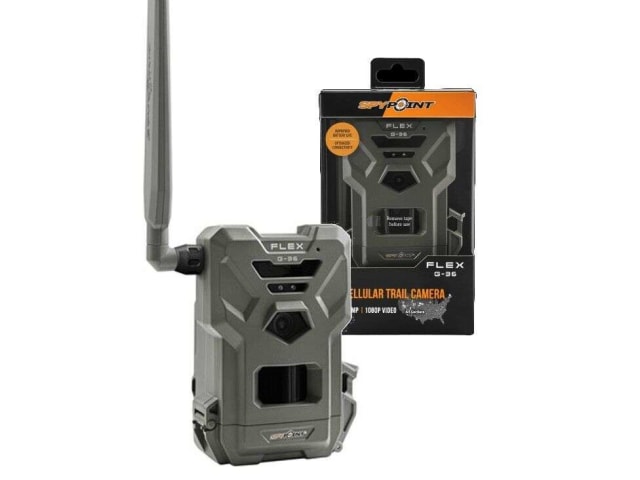
36MP photos, free data plan, and the best app in the category, the easiest way to get cellular scouting.
The 2026 news
SPYPOINT's FLEX-RANGE: satellite backup, finally.
At SHOT Show in January 2026, SPYPOINT unveiled the FLEX-RANGE, billed as the first consumer trail camera with native satellite backup. It pairs dual-carrier LTE (auto-switching between AT&T and Verizon) with a satellite fallback for deployments that go dark on cellular. 40MP stills, 1080p HD video with audio, reinforced housing, and either a LIT-22 rechargeable pack or 6 AA batteries.
SPYPOINT has not disclosed the satellite constellation partner, final pricing, or a firm ship date. The camera is expected to reach North America later in 2026. Treat this as a preview, not a shipping product.
Sourced from The Outdoor Wire.
Related rankings
Go deeper.
Individual reviews
Camera-by-camera.
Other connectivity types
Compare the four trail camera categories.
Cellular trail cameras
Photos pushed to your phone over LTE within minutes. Best for active scouting on a recurring data plan.
WiFi trail cameras
Walk-up sync. Camera broadcasts its own short-range WiFi, phone connects via app, no subscription.
Non-cellular trail cameras
SD card pulls only. Lowest hardware price, longest battery life, zero subscriptions.
Frequently asked
Questions hunters actually ask.
Not sure which fits?
Run the 4-question camera finder.
Picks a camera based on connectivity, use case, power source, flash type, and budget.
Start the finder →