
Category guide · 3 top picks
Scouting
Cameras: For Pattern Tracking Between Seasons
Scouting cameras for hunters working between seasons — long battery, lockable housing, decent low-light. Picks chosen for the workflow, not the gear-review feedback loop.

Cross-referenced against Rokslide and QDMA threads, spring 2026.
The top picks
Three cameras to start with.
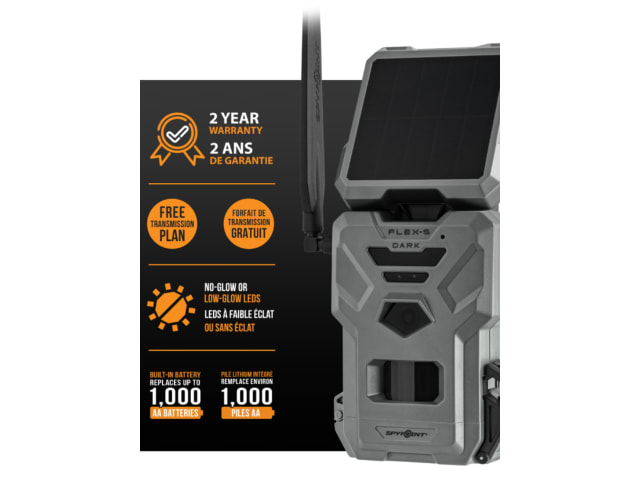
The SPYPOINT Flex-S-Dark is a no-glow cellular trail camera with an integrated solar panel and 40MP still imaging, designed for extended low-maintenance deployments where site pressure and battery longevity are primary concerns.

The Moultrie Edge 3 Pro is a mid-tier cellular trail camera distinguished by a 50MP sensor, 1440p QHD video, integrated GPS, and app-side AI buck detection, positioning it as a feature-dense option for hunters managing multi-camera setups on pressured ground.

24MP no-glow flash with a 0.2-second trigger, the best invisible-flash camera for serious deer hunters under $150.
Search "scouting cameras" on Google in April 2026 and you'll get Browning's category page, Moultrie's category page, Bass Pro's filtered grid, and an Amazon storefront. Nobody is actually explaining the word. That's the gap.
Scouting is what hunters do between seasons. It's not the same as hunting. In July you're trying to learn a buck's summer pattern, which alfalfa edge he's hitting at last light, which transition zone between bedding and food he uses when the velvet is still on. By late September you're watching for the rub line and the first scrape behavior on a south-facing creek bottom. In January, on the late-season survival check, you just want to know who made it through the rifle pressure. A scouting camera does that work for you while you're at your job.
The hardware demands are specific. You need battery life measured in months, not weeks, because a card pull every Saturday isn't realistic on a 90-acre lease two hours from your driveway. You need a unit that plays nice with onX or HuntStand pin-drops so you can actually find the tree again in November. If you're hunting genuinely remote ground (northern Maine, the Bitterroot, parts of the Idaho panhandle) cellular signal becomes a real conversation, and "Verizon coverage map" is a more honest filter than "best megapixels."
The picks on this page were chosen for that workflow, not for the gear-review feedback loop. Long battery, lockable steel housing, decent low-light because the deer move at 5:47 a.m. and not at noon, and either an SD-only build for the trees you visit weekly or a true LTE cam for the ones you visit twice a year. We checked each against threads on Rokslide and the QDMA forum through spring 2026 to see what's actually surviving a Wisconsin winter.
The summer scout: July to early September
This is when scouting cameras earn their name. From velvet through hard-antler shed in early September, you're inventorying the bucks that summered on your ground. Cameras go on mineral sites, food plot edges, and the alfalfa cuts where deer feed predictably. The window matters: a buck that's hitting your soybean field at 7:30 p.m. in July may shift his pattern 600 yards east by October when the acorn drop starts.
Battery life is the make-or-break spec for summer scouting. You're deploying for 8 to 12 weeks without a check, often in 90°F-plus temperatures that drain alkalines fast. Lithium AAs last 30 to 50 percent longer than alkalines in heat above 80°F, and they're worth the $1.50 per battery upgrade for any deployment past 6 weeks.
Pre-rut and rut: late September to mid-November
Once velvet is off and the rub line lights up, scouting shifts from inventory to pattern tracking. You want trigger speeds under 0.4 seconds because a buck checking a scrape pauses for 3 to 8 seconds before moving on. You want detection range over 60 feet for funnel locations, and tighter range (30 to 40 feet) for active scrapes where the deer are already inside the zone.
This is also where cellular scouting cameras earn their monthly fee. A photo of a target buck delivered to your phone at 4:42 a.m. on October 12 means you can decide before sunrise whether to hunt the morning. The same buck on an SD card you'll pull Saturday is intelligence you got too late.
The late-season survival check
After rifle season closes, late January through March, scouting cameras tell you who's still alive. This matters for next year's plan. Cameras on south-facing thermal cover, late food sources like standing corn or browse cuts, and on the staging trails between them. Battery drain accelerates below 20°F, even with lithiums, so plan for a check every 4 to 6 weeks on cold-climate properties. Models with built-in solar panels stretch deployments to a full season without intervention.
How many cameras you actually need
Most hunters over-deploy and under-think. On a typical 80 to 160-acre Midwest lease, three to four cameras cover the high-traffic spots: a primary food source, a transition pinch, a creek crossing, and one active scrape during the rut. Going past six on that acreage usually produces redundant data, not new intelligence.
Larger ground changes the math. On a 500-acre Western public-land hunt, six to twelve cameras across mineral sites, water tanks, and travel corridors will yield enough pattern data through August and September to consolidate to two or three primary stand sites by the rifle opener. The cameras you don't deploy where the buck lives can come back into the truck before opening day.
The opposite mistake is more expensive: running too few cameras and missing the buck entirely. A single camera on a heavily used scrape line will produce 30 to 60 buck photos in October, but only of the bucks using that exact trail. Two cameras on parallel scrape lines 80 yards apart capture twice the inventory and reveal which bucks favor which corridor. The math works out to roughly one camera per 25 to 35 acres of huntable ground, with a hard floor of two on any property over 40 acres.
Scout cameras also benefit from rotation. Hunters who leave the same camera on the same tree for 18 straight months see deer pattern around it: bucks will skirt a known camera location once they've seen the IR flash a few times, even on no-glow units. Moving each camera 30 to 60 yards once a season, ideally before the rut, restores the data quality and keeps your inventory honest.
Related rankings
Go deeper.
Individual reviews
Camera-by-camera.
Frequently asked