

Ranking · 2 cameras reviewed
Best Wi-Fi Trail Cameras of 2026. No Cellular Plan Needed
Best Wi-Fi trail cameras of 2026 ranked by specs, features & user reviews. No cellular plan required. Top picks include GardePro E8 & E6.

We may earn a commission from purchases made via affiliate links on this page, including the Amazon Associates program. Editorial rankings are not influenced by commissions. Full disclosure.
The top picks
At the top of this ranking.

The GardePro E8 2.0 is a non-cellular WiFi trail camera targeting property owners who want on-site app-based image viewing at 4K resolution without monthly subscription fees.

The GardePro E6 is a mid-range Wi-Fi-enabled trail camera aimed at hunters and wildlife watchers who want high-resolution stills and wireless connectivity without a cellular subscription.
The full ranking
At a glance.
| Rank | Camera | Connectivity | Score | |
|---|---|---|---|---|
| 1 | GardePro E84K WiFi trail cam with no-glow IR and app viewing | WiFi | 7.7/10 | Check price → |
| 2 | GardePro E648MP Wi-Fi trail camera with IP66 weatherproofing | WiFi | 7.2/10 | Check price → |
At a Glance
The GardePro E8 ($129.99) takes the top overall spot with a claimed 0.1-second trigger, 64MP stills, 4K video, and a 165-foot Wi-Fi radius. Buyers watching their budget will find strong value in the GardePro E6 ($99.99), which delivers 48MP resolution, 1296p video, and IP66 weatherproofing powered by standard AA batteries.
How We Ranked These
Scoring is transparent. We ranked these cameras using a defined set of criteria applied consistently across all candidates: trigger speed (manufacturer-published figures), detection range, image and video resolution, weatherproofing rating, battery configuration, and Wi-Fi connectivity specs. Trigger speed and detection range together account for capture reliability, so they carry more influence in our scoring than secondary factors like app interface ratings.
Source material came from two channels. Manufacturer specification pages and product listings established hard numbers for each camera. Aggregated Amazon reviews were then analyzed for patterns in buyer-reported reliability, specifically around connectivity stability, night image quality, and battery behavior. Where published specs and buyer-reported experience diverge, we note both.
This roundup covers Wi-Fi trail cameras only. These are cameras that transmit images to a phone or app over a local wireless connection; cellular models, which send images over a carrier network, fall outside the scope of this list. All cameras here require the user to be within wireless range to retrieve images, and that proximity requirement shapes the buying advice that follows.
Scores on each camera card reflect a weighted composite across the criteria above. Editorial order reflects those scores, not advertising relationships or affiliate yield.
What to Look For When Buying
Trigger Speed
Trigger speed determines whether the camera fires before a deer steps out of frame. For active scrapes, pinch points, or any location where animals move through quickly, a trigger at or below 0.3 seconds is the practical threshold to target. The GardePro E8 publishes a 0.1-second trigger, sitting well below that threshold. The GardePro E6 publishes 0.3 seconds (sometimes listed as 300ms), which qualifies as competitive in the mid-range bracket. Cameras with triggers above 0.5 seconds tend to perform well at stationary feeders or slow-traffic locations where timing pressure is lower.
Detection Range and Coverage
Detection range sets the perimeter within which the passive infrared sensor will trigger the camera. The GardePro E8 publishes a 100-foot detection range; the GardePro E6 lists 75 feet. For a narrow trail or a tight funnel, 75 feet is sufficient. Monitoring a wide food plot or open field benefits from the longer 100-foot range, though detection angle (the horizontal width of the sensor's coverage) matters equally. The E6's detection angle is not published by the manufacturer, which makes coverage-width comparisons to the E8 difficult to confirm from available specs alone.
Image and Video Resolution
Resolution affects how usefully you can identify animals at distance. At 48MP, the GardePro E6 already exceeds what most budget cameras offer; at 64MP, the GardePro E8 captures finer detail across the full frame. For video, the E6 shoots 1296p, which exceeds the 1080p standard common in this price tier. The E8 records at 4K, the higher spec by a clear margin. Higher resolution also means larger files, so SD card capacity and file management become relevant decisions when choosing between the two.
Battery Configuration and Runtime
Battery type shapes long-term deployment cost. The GardePro E6 runs on 8 AA batteries, a configuration that is easy to swap in the field with widely available cells. The GardePro E8 uses an internal lithium battery, which removes the per-deployment battery cost but requires a charging decision before each placement. Neither camera includes a day-count battery life estimate in its published specs; buyers writing on Amazon are currently the primary source of real-world runtime data for both models.
Wi-Fi Range and App Connectivity
Because both cameras on this list are Wi-Fi only, the wireless connection radius is a meaningful placement factor. The GardePro E8 specifies a 165-foot Wi-Fi radius via its dual-antenna system, a figure the manufacturer publishes in its product listing. The GardePro E6 does not include a comparable range figure in its published specs. In practical placement terms, 165 feet means you can pull images from a truck or field edge without walking to the tree. A shorter or unspecified radius may require closer approach, which increases disturbance near active sign.
Bottom Line
Two cameras. Two clear use cases. Buyers who want the highest-spec Wi-Fi trail camera in the sub-$150 range should look at the GardePro E8: its 0.1-second trigger, 64MP resolution, 4K video, and dual-antenna Wi-Fi at $129.99 represent a spec sheet that Amazon reviewers have broadly confirmed is competitive for the price. Those who prefer AA-battery convenience and a lower entry cost will find the GardePro E6 at $99.99 a capable option, with 48MP stills and 1296p video that exceed what the budget tier typically delivers. Both cameras carry IP66 weatherproofing and require no cellular subscription.
Sources
This roundup draws on the following sources:
Quick picks by need
One winner per category.
Showing 2 of 2 cameras

The GardePro E8 2.0 is a non-cellular WiFi trail camera targeting property owners who want on-site app-based image viewing at 4K resolution without monthly subscription fees.
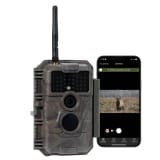
The GardePro E6 is a mid-range Wi-Fi-enabled trail camera aimed at hunters and wildlife watchers who want high-resolution stills and wireless connectivity without a cellular subscription.
Spec comparison
Side by side.
| Spec | GARDEPRO e8 | GARDEPRO e6 |
|---|---|---|
| Trigger Speed | 0.30s | 0.30s |
| Megapixels | 64 MP | 48 MP |
| Flash Type | No-Glow (940nm) | Standard IR |
| Battery Life | Not specified | Not specified |
| Monthly Plan | N/A | N/A |
| Free Plan | None | None |
| Live Streaming | Yes ✓ | — |
Frequently asked
Questions hunters actually ask.
Other rankings worth comparing
Related buyer rankings.
Not sure which fits?
Run the 4-question camera finder.
Picks a camera based on connectivity, use case, power source, flash type, and budget.
Start the finder →